
Home making
By Heather Moqtaderi
INTRODUCTION
When I began my curatorial role with the National Audubon Society, my first call was to Deirdre Murphy. For years, I had followed her practice of merging bird conservation data, color theory, and expressive painterly technique. Murphy has held numerous artist residencies, one of which took place at the Winterthur Museum where she was included in the exhibition Transitions. Her public works also caught my attention, such as her recently commissioned Flyways sculptural bench at Washington College’s Foreman Branch Bird Observatory and Birdsong mural at Schauffele Plaza in Ardmore, Pennsylvania.
Fort is a painting that depicts a structure built by preschoolers at the Lower Merion Conservancy in Gladwyne, Pennsylvania, where Murphy is a long-term resident artist. The fort is framed by vivid green graduating upwards from opaque to transparent. This vignette effect is inspired by the shape of a tree cavity, an opening that typically begins as a hole pecked by a woodpecker or other tree-clinging bird. Eventually, the opening widens and serves as habitat for cavity-nesting birds, such as owls. The painting’s composition situates the viewer as a bird looking outward at the manmade fort, which is a bit like an upside-down nest. By offering this “bird’s-eye view,” Murphy inverts our relationship as viewers. Instead of birdwatchers, we become bird watchers.
In the pages that follow, I share artworks in Deirdre Murphy’s exhibition Home Making. My observations are based on conversations with the artist and time spent with her artwork in studio. Murphy’s practice brings together her ongoing studies of the natural environment with colorful abstraction that conveys a sense of awe and wonder. Murphy describes her process as the “act of looking with sensorial awareness.” Through this balance of natural realism and painterly expression, Murphy portrays bird habits and habitats, as well as the exhilaration of experiencing them in nature.
HOME MAKING
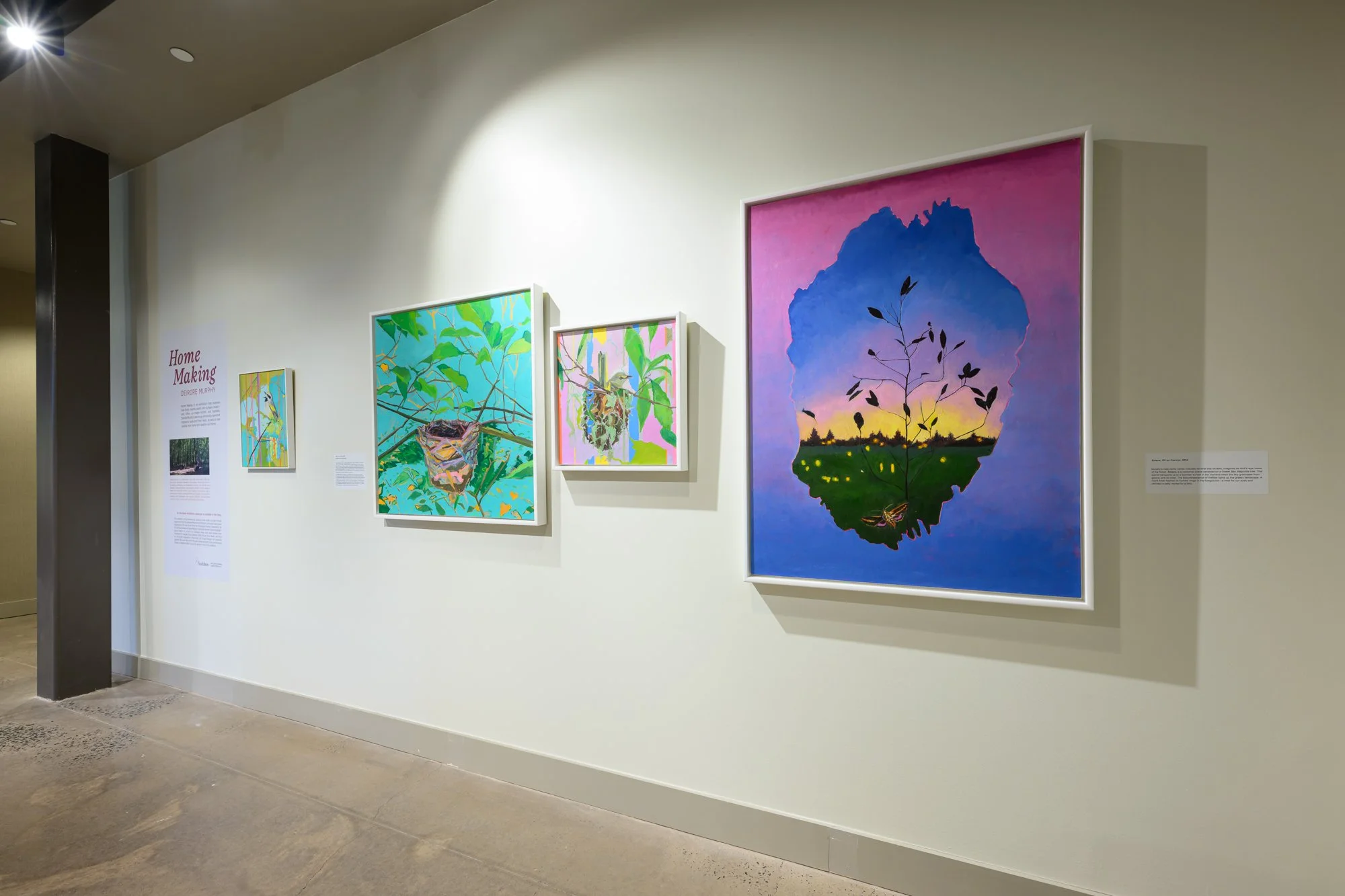
No matter how many times I happen upon a bird nest, I feel a surge of delight and wonder. If the bird family is in residence, there is such joy in observing their activity from a distance. More often than not, “nobody’s home,” and I am left to wonder who labored, loved, and lived in the avian abode. Murphy evokes the joy of nest discovery in Brooding Season. The painting invites us into a sunlit canopy of green leaves. From our upward-gazing perspective, we discover a nest suspended in the leafy branches. Murphy painted this nest in the vibrancy of mid-summer, conveyed through the vividness of verdant green leaves and lemon-yellow sunlight. The density and closeness of the foliage evoke the feeling of being within the understory, having pushed aside branches and brush to enter this hidden world.
Brooding Season is part of Murphy’s Nest Alchemy series. For this body of work, she studied nest forms of migratory birds in southeastern Pennsylvania. Nests vary dramatically in structure, materiality, size, and location, depending on the bird species. Murphy studied cup nests, drawing them from various angles to enable her to better understand their varied structures. This American Robin’s nest in Brooding Season is a cup formed of twigs, leaves, grasses, and incidental materials like paper and scraps of manmade detritus. Murphy’s rendering balances pictorial representation with sensorial impression, sharing a sense of how this moment looks and feels. In an interview, she describes the challenge of painting such a loose structure: “This was very difficult to paint because of all those dangling bits and wanting to learn the weaving structure, but I didn’t want to apply my own need to find systematic patterns.”
The purpose of any nest is to incubate eggs and protect young. For smaller birds, camouflage is essential for hiding the nest from predators. By their very nature, nests are difficult to see. Many birds add lichen and bark to blend in with the surrounding canopy. This camouflage disguises nest homes from predators and parasitic birds who deposit their own eggs in other species’ nests. In Brooding Season, Murphy shifts our attention to make visible the nearly invisible. She achieves this through rendering the nest in sharper focus against an impressionistic treatment of the sunlight and leaves. Murphy paints the suggestion of dappled summer sunlight illuminating a leafy canopy. Her painterly leaves are gestural, undulating in a range of shades from light green to turquoise. Her brushwork suggests the tree’s branches through strokes of purplish brown extending upward, drawing our gaze upward to the composition’s focal point, the nest.
In Golden Hour, the autumn season dictates the color palette. We look upward into the branches of a Smoke Bush with red and orange fall foliage set against a turquoise sky. Murphy uses the tree’s outward-reaching shoots to segment the picture plane, creating a curved grid of colored sections. This creates an effect similar to a stained-glass window. Murphy plays with opacity and transparency, heightening the sensation of sunlight through stained glass. The abstraction of the composition is balanced by Murphy’s naturalistic portrayal of the nest habitat.
The nest is portrayed as she found it in nature, securely nestled into the confluence of shoots. Murphy describes her process: “There was a Robin’s nest and I tucked myself under to paint. I love the big, long angles of Smoke Bush branches. I tried to stay painterly and not overpaint, scratching in to find the golden under-color.”
American Robin’s nests are constructed by female birds who build their nests from the inside out. The bird creates a deep cup form of grasses and other soft material, combined with soft mud—all molded using the contours of her body. Feathering the Nest celebrates this avian choreography. In her research, Murphy studied a video of a Robin building her nest, comparing the movements to modern dance: “The Robin shaped her gorgeous nest with her bosom and her rump. Her tail would do these odd shapes. Her wings would contort back. At the end of this
fever dance there was this beautiful cup nest.” Murphy painted the nest-building scene expressively, moving her brush with full body strokes across the canvas. The composition is saturated with orange, a color associated with energy and creativity, perfectly reflecting the Robin’s nest-building movements, not to mention the color of its reddish-orange breast feathers.
The White-eyed Vireo is a species distinguished by white “spectacles” encircling its eyes, as seen in Murphy’s Vireo painting. She depicts the parent bird in brooding behavior, sitting on its clutch of eggs to offer warmth and protection. We don’t know whether this is the mother or father bird, because both male and female White-eyed Vireos incubate their eggs; Vireos are also monomorphic—males and females look alike. The White-eyed Vireo’s nest is distinctive in its cone-shaped form, lashed to the forked twigs of low shrubs, hanging as a pendulum.
Male and female Vireos build their nests of small pieces of soft wood and bark shreds, held together with insect silk and spiderweb. The birds “decorate” their nest with plants materials, such as lichen and moss, as camouflage. The female bird lines the nest with soft material, such as rootlets, grass, and hair. Murphy’s Vireo plays with camouflage, overlapping the abstract patterned background with the nest and plant materials. The bird is embedded into the background as well, the vertical stripes picking up on its yellow tailfeathers and gray-green head.
In Crucible, Murphy’s subject is an uninhabited Vireo nest. Since the nest was unoccupied, she was able to elevate her viewpoint without disturbing nesting birds. Our downward gaze allows us to glimpse the nest’s woven interior. Murphy describes Crucible as a “summer scene, keeping the vibrancy of forest, bringing in greens as orange light flickers through, to feel like we are in the understory.” She increased the color saturation of the delicate pink-brown bark strips, creating jewel tone highlights. Murphy describes her intention: “When you find a nest in the woods, it is like finding a jewel, and adding the pinks and violets conveys that preciousness.”
Owl shifts our vantage point to a bird’s-eye view, looking outward from a tree cavity. Murphy based this scene on her observations of Great Horned Owls at her Lower Merion Conservancy artist residency. She recalls hearing them calling to one another in the evening, echoing across the forest. In Owl, she imagines an owl’s-eye view of a family member flying home to roost in its tree cavity. In contrast to the magenta and purple vignette, the owl and surrounding winter landscape are muted shades of white to gray to lavender. The painting captures feeling of wonder at catching a glimpse of this majestic raptor. Murphy explains her intent for conveying bird biology as well as emotion: “There’s that balance of being true to the species but also being gestural and emotive about the zeitgeist of the painting.”
Murphy’s nest cavity series includes several tree studies, imagined as bird’s-eye views of the forest. Solace is a nocturnal scene centered on a Sweet Bay Magnolia tree. The scene transports us to a summer sunset in the moment when the sky graduates from gold to pink to violet. The bioluminescence of fireflies lights up the grassy landscape. A Hawk Moth flashes its fuchsia wings in the foreground—a treat for our eyes and perhaps a tasty morsel for a bird. Vernal Spring evokes a more nuanced expression of season—the transitional time from winter to spring. The tree cavity shape is less defined here, exploring the feeling of a portal between worlds. Murphy describes the sensation: “Through auras of color that pulsate almost imperceptibly, I wanted to create bleed moments where you weren’t sure if you were inside or outside. I was able to let go of the look of things and get into the feeling of things.”
In Hemlock Grove, Murphy creates the feeling of being inside a veil of Hemlock tree branches. This painting comes from Murphys Long-Term Ecological Reflections residency at Shaver’s Creek. During the residency, she studied the site’s ecology, including Hemlock trees threatened by disease. Hemlock trees are an important source of food and shelter for birds and other wildlife, along with providing shade for keeping streams cool for aquatic life. This close study, done in plein air, focuses on the Hemlock’s branch and needle forms. The close-up vantage point invites viewers to feel part of the picture plane—a slippage between worlds. Murphy explains: “I wanted to create a sublime kind of slippage, like ‘where am I in the painted world’? That feeling. That’s what I love when a painting transports you; you forget yourself, in a suspended painted world. I’m always trying to paint that wonderment.”